


Calculate square feet for flooring to kickstart your home renovation project with confidence. Understanding the total square footage of your space can make or break your budget. By following a few simple steps, you will know exactly how much flooring you need, ensuring every dollar is spent wisely. Here's a quick process:
- Measure the length and width of the room in feet and inches.
- Round up each measurement to the nearest inch.
- Convert measurements to total feet by dividing inches by 12.
- Multiply length by width to find the square footage.
- Add an overage of 5%-10% to cover any installation mishaps.
Whether you're dealing with a simple square room or complex layouts, starting with an accurate square footage calculation is crucial. Reliable measurement and calculation ensure that you're choosing the right materials and avoiding costly mistakes.
Flooring is a major investment in the beauty and functionality of your home. By ensuring accurate calculations, you make informed decisions that set the stage for a successful renovation.

Step 2: Convert Measurements to Feet
Once you've gathered your room measurements in feet and inches, it's time to convert these measurements into feet. This step is essential for accurate calculations when you calculate square feet for flooring.
Why Convert to Feet?
Most flooring materials and costs are calculated in square feet. To ensure precision, you need to work with measurements in feet, not a mix of feet and inches.
How to Convert Inches to Feet
Here's a simple method to convert inches to feet:
- Take the Inches from Your Measurement: Look at the inches in your measurement. For example, if your room length is 12 feet and 7 inches, focus on the 7 inches.
- Divide Inches by 12: Since there are 12 inches in a foot, divide the inches by 12 to convert them to a decimal. For instance, 7 inches divided by 12 equals approximately 0.583 feet.
- Add the Decimal to the Feet: Add this decimal to the feet part of your measurement. In our example, 12 feet plus 0.583 equals 12.583 feet.
This conversion process is crucial for ensuring all your measurements are in the same unit, making it easier to calculate square footage accurately.
Example Conversion
- Length: 12 feet 7 inches becomes 12.583 feet
- Width: 9 feet 6 inches becomes 9.5 feet
By converting your measurements to feet, you can now multiply them to find the total square footage. This step is a foundation for precise flooring calculations, ensuring you buy just the right amount of material for your project.
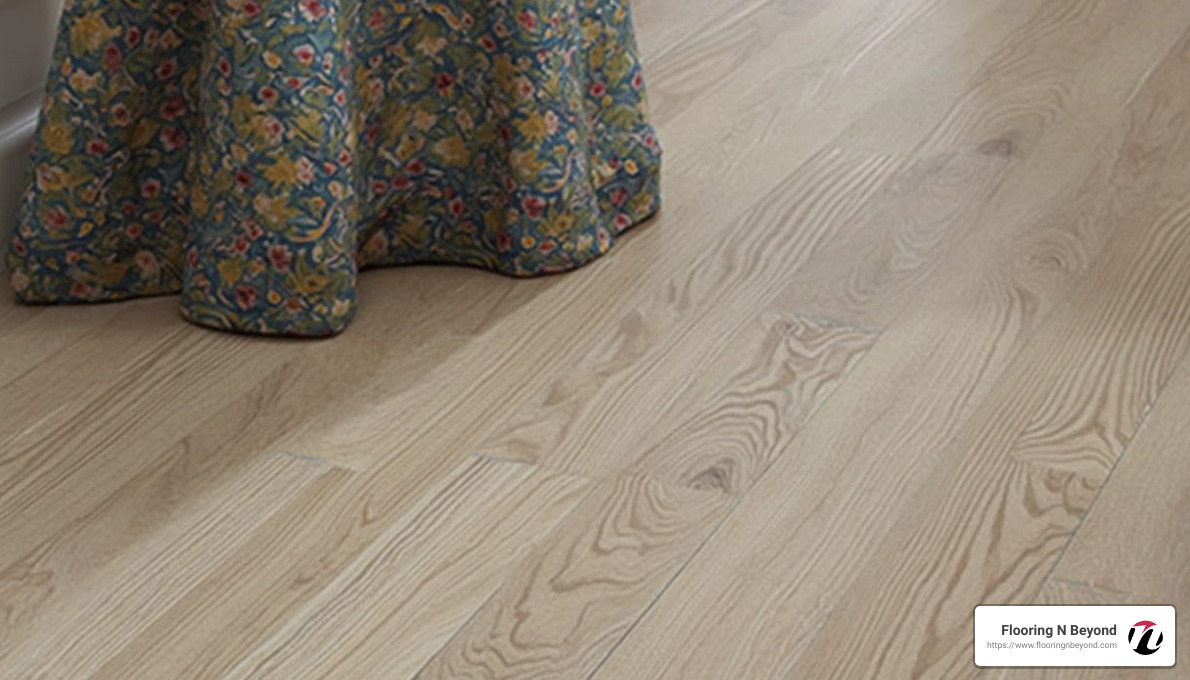
Every inch counts when it comes to flooring. Converting measurements properly helps avoid overbuying or underestimating the materials needed for your renovation.
Step 3: Calculate Square Footage
Now that your measurements are all in feet, it's time to calculate square footage for flooring. This is where the magic happens, as you'll determine how much material you'll need for your project.
Calculating for Rectangular Areas
For a straightforward rectangular room, calculating square footage is simple. Just multiply the length by the width.
Example: If your room is 12.583 feet long and 9.5 feet wide, the calculation is:
[ \text{Area} = \text{Length} \times \text{Width} = 12.583 , \text{ft} \times 9.5 , \text{ft} = 119.54 , \text{sq ft} ]
This tells you that the room is approximately 119.54 square feet.
Tackling Irregular Shapes
Not all rooms are perfect rectangles. If your space is an irregular shape, break it down into smaller rectangles or squares. Calculate the area for each section and then add them together.
Steps for Irregular Shapes:
- Divide the Space: Identify and separate the room into smaller rectangular sections.
- Calculate Each Section: Use the length x width formula for each section.
- Add the Areas Together: Sum up the areas of all sections to get the total square footage.
Example: Imagine a room shaped like an 'L'. Divide it into two rectangles. Calculate the area of each and add them:
- Rectangle 1: 10 ft x 4 ft = 40 sq ft
- Rectangle 2: 6 ft x 8 ft = 48 sq ft
Total area = 40 sq ft + 48 sq ft = 88 sq ft
By breaking down irregular shapes into simpler parts, you can accurately calculate the square footage needed. This method ensures you have the right amount of flooring material, avoiding costly mistakes.
With these calculations in hand, you're ready to move on to the next step: considering overage to account for any installation mishaps or odd dimensions.
Step 4: Add Overage for Material
Even with precise measurements, plan for a bit extra when purchasing flooring materials. This extra amount, known as overage, helps cover any unexpected issues that may arise during installation.
Why Consider Overage?
Installation Mishaps: Mistakes can happen during installation. Whether it's a miscut or a piece that doesn't fit quite right, having additional material can save the day.
Odd Dimensions: Rooms with unusual shapes or features like alcoves and closets may require more flooring than initially calculated. Extra material allows for adjustments without stress.
Material Variations: Some materials, like wood and tile, can have variations in color and pattern. Having extra ensures you can select pieces that match well.
How Much Overage Do You Need?
A general rule of thumb is to add 5% to 10% overage to your total square footage. This buffer accounts for the factors mentioned above and ensures you won't run short.
Example:
If your calculated square footage is 119.54 sq ft, calculate 10% overage like this:
[ \text{Overage} = 119.54 , \text{sq ft} \times 0.10 = 11.95 , \text{sq ft} ]
Add this to your original measurement:
[ \text{Total with Overage} = 119.54 , \text{sq ft} + 11.95 , \text{sq ft} = 131.49 , \text{sq ft} ]
Round up to the nearest whole number, so you'll need 132 sq ft of material.
Special Considerations
- Laminate and Wood Flooring: These materials often require a bit more overage due to cutting and fitting around corners and obstacles.
- Carpet: For carpet, consider up to 20% overage, especially if you're working with patterns that need to match.
By planning for overage, you ensure that your flooring project runs smoothly. You'll have enough material to handle any surprises, making the process less stressful and more efficient.
Now that you've accounted for overage, you're ready to estimate the total cost of your flooring project. Let's explore how to calculate the price per square foot and what factors to consider.
Step 5: Estimate Total Flooring Cost
Once you've calculated the total square footage, including overage, it's time to estimate the total flooring cost. This involves understanding the price per square foot and considering any additional expenses.
Price Per Square Foot
The price per square foot is a crucial factor in determining your flooring budget. It varies based on the type of material you choose. For example, tile flooring can range from as low as $0.60 to hundreds of dollars per square foot, depending on the type and quality.
Example: If you choose a tile that costs $5 per square foot and need 132 square feet (including overage), your material cost will be:
[ \text{Material Cost} = 132 , \text{sq ft} \times $5/\text{sq ft} = $660 ]
Additional Costs
- Installation: Professional installation can add to your total cost. This varies by material, with some like tile being more expensive due to complexity.
- Underlayment: Some flooring types, like laminate, require underlayment. This is an extra layer that provides cushioning and moisture protection.
- Accessories: Don't forget about baseboards, transition strips, and other accessories that complete the look.
Get a Quote from Flooring N Beyond
To get a more accurate estimate, consider requesting a free estimate from Flooring N Beyond. Their experts can help you assess your needs, compare different materials, and provide a detailed cost breakdown. Visit their website at Flooring N Beyond.
Comparing Costs
Create a simple chart to compare the total cost of your top flooring choices. Include the price per square foot, installation fees, and any additional costs. This will help you make an informed decision that fits your budget.
By understanding these costs, you can plan effectively and avoid unexpected expenses. This ensures a smooth and successful flooring project, changing your space beautifully and efficiently.

Frequently Asked Questions about Calculating Flooring Area
How do I calculate how much flooring I need?
To calculate square feet for flooring, you'll need a tape measure to gather the length and width of the room. Simply multiply these two measurements to get the total square footage. For example, if your room is 15 feet long and 10 feet wide, the area is:
[ \text{Area} = 15 , \text{ft} \times 10 , \text{ft} = 150 , \text{sq ft} ]
For irregularly shaped rooms, divide the space into smaller rectangles, calculate each area, and then add them up.
How to calculate price per square foot for flooring?
To estimate the cost of flooring, first determine the total square footage required, including any overage for installation mishaps. Then, multiply this by the price per square foot of your chosen flooring material. For instance, if you need 150 square feet and the flooring costs $4 per square foot, the calculation would be:
[ \text{Total Cost} = 150 , \text{sq ft} \times $4/\text{sq ft} = $600 ]
This gives you a basic estimate, excluding additional costs like installation or underlayment.
How many square feet is a 12x12 floor?
A 12x12 room is a perfect square and calculating its area is straightforward. Multiply the length by the width:
[ \text{Area} = 12 , \text{ft} \times 12 , \text{ft} = 144 , \text{sq ft} ]
This means you'll need 144 square feet of flooring material to cover the entire area, not accounting for any overage.
For more detailed assistance and to explore flooring options, check out our Flooring Services at Flooring N Beyond. Our experts are ready to help you make informed choices for your next flooring project.
Frequently Asked Questions about Calculating Flooring Area
How do I calculate how much flooring I need?
tape measure, length x width
How to calculate price per square foot for flooring?
total square feet, price estimation
How many square feet is a 12x12 floor?
12x12 room, 144 square feet
Conclusion
Flooring N Beyond, professional installation, project budget


